
Life at Tremont involves doing things that are hard for some people. Alongside our students and adult participants, we climb mountains, wade in cold streams, and hike in the nighttime forest (without a light!), all while embracing sweat, rain, and rarely just-right temperatures. In all this, we ask our guests to trust that stepping outside our comfort zones makes us better human beings wiser to our abilities and dependency on the earth and each other.
Doing hard things can include building bridges. Actually, figurative bridge-building isn’t all that hard. After all, the closer ties formed between people and between people and the beauty of the Smokies comes pretty naturally.
Literal bridges, on the other hand, don’t get built very often, but one did at our second campus recently.

Still just a log, not yet a bridge. Elizabeth is standing in the creek bed that the log bridge will eventually span.

Elizabeth sawing the log in two to create a level walking surface. Had we come prepared with bags, we might have made a hefty profit selling the sawdust to gerbil owners.

Putting the finishing touches on the split log. The narrower slab will be used for a bench.
Its construction was indeed a hard task because Elizabeth Davis and I didn’t really know what we were doing when we began work on it. We didn’t let this stop us though. Through trial and error, we figured it out day by day. Each day, we hauled equipment a half-mile up the steep trail, sized up our newest challenge, and then pushed and pulled and perspired until we faced the next one. In doing this, as we had many times before, we joined the ranks of manual laborers who perform demanding physical tasks on a regular basis.
What society today calls “manual labor” has been the primary kind of work human beings have carried out for most of human history. Then as now, it involves sacrifice. It’s hard on the body, as many people who engage in it on a daily basis—construction workers, farm workers, loggers, welders, electricians, roofers, equipment operators, firefighters, and many others—can attest.
Manual labor was once seen as a respectable career path by which a person could make a living wage. Increasingly over the past forty years, however, the so-called “knowledge economy,” largely based in metropolitan areas, has come to be seen as more important and necessary. Factory jobs have been deemed expendable and shipped to other countries, and as a result, rural communities and small towns have suffered major declines and a sizeable cross-section of the American public has grown resentful over feeling left behind.
In case it isn’t obvious by now, I’m a proponent not only of physical labor but also of granting more respect to those who do it. But there is another reason I bring all this up, and it has to do with bridges.
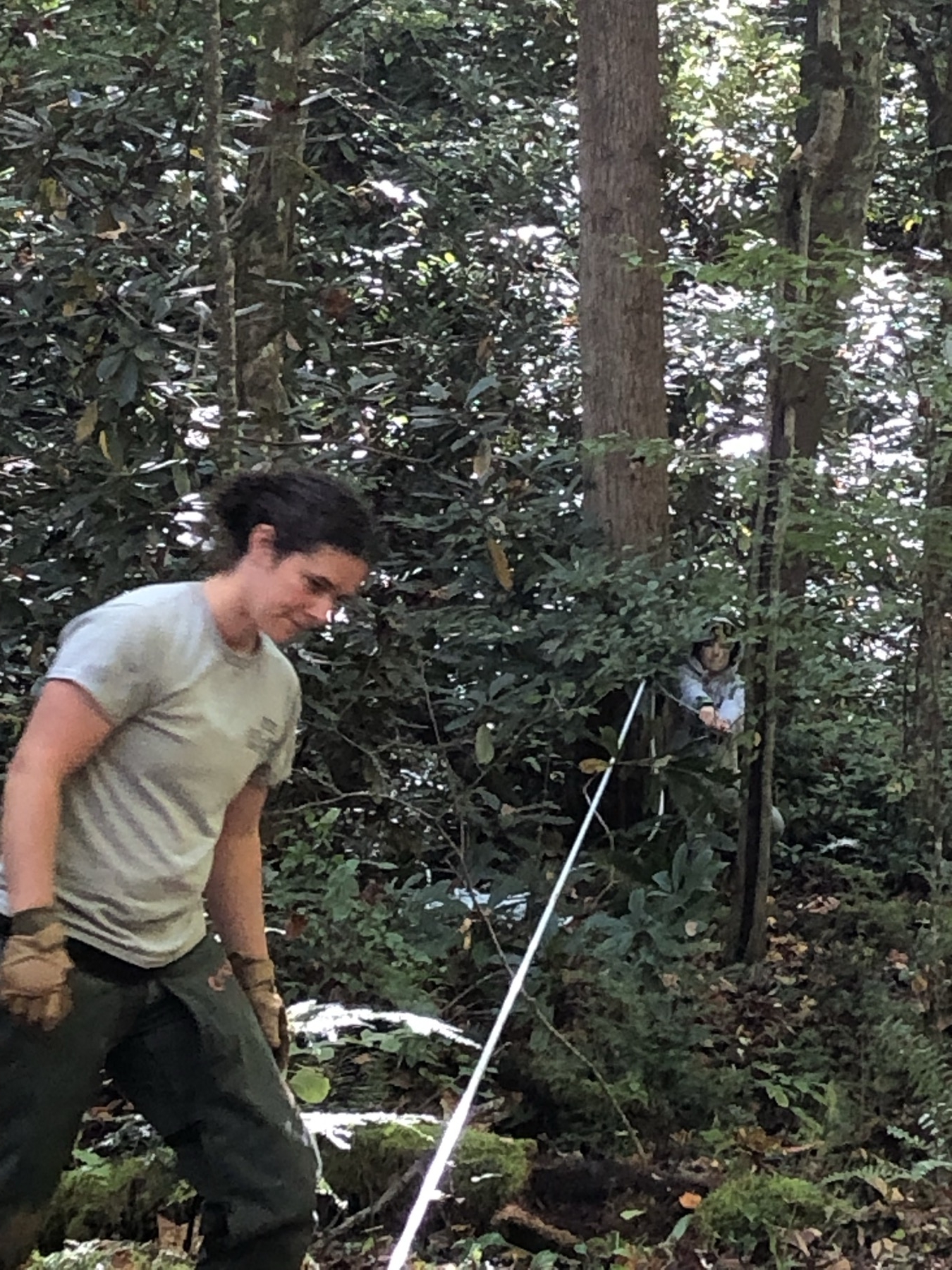
The rope connects to the log on one end (out of sight in the foreground), and on the other to a come-along system. Look closely for my son Ethan, age ten, who is cranking on a Maasdam rope puller.

Without any assistance from adults, Ethan pulls the log across the creek.

Tremont trail volunteer Rick Hughes happened to pass by at just the right time. Here he is moving a rock into place as a footer for the bridge.
Physical labor builds bridges between the body and the intellect in ways that sitting at a desk or staring at a screen all day cannot. As an embodied form of learning, it’s an antidote to the Cartesian dualism that separates mind from body and which has tipped the balance in Western culture toward a brain-centered view of intelligence, often to the exclusion of a more whole understanding of what it means to be human. Physical labor reminds us how vitally important geography and place are (“I am preparing this soil in this garden at this latitude to plant these seeds”). What’s more, a deep satisfaction and pleasure that comes from it, which I hope these photos will show.
Like many other forms of “experiential learning,” including hiking and catching salamanders, manual labor puts us in touch with deep undercurrents that ground us in reality like almost nothing else can. Philosopher Simone Weil puts it this way:
Exactly to the same extent as art and science, though in a different way, physical labour is a certain contact with the reality, the truth, and the beauty of this universe and with the eternal wisdom which is the order in it.

Elizabeth notches the log to fit the footer.

Enjoying the fruits of our labor, Asher included (Elizabeth’s dog seated next to Ethan).

Six days later, adults with our annual Sierra Club Hiking Week walk on the bridge while exploring the second campus.
I wanted to share these photos so you might feel a part of the goings-on at our second campus, much of which will include outdoor work of the rugged, sweaty, exhausting but immensely gratifying kind. (We’re always looking for volunteers!)
Completing our log bridge (minus handrails) took four days over the course of several months. First, we had to fell the tree safely. Returning several weeks later, we cut a section of log to length and rolled it down a hillside to a trail for easier access. On day three, we skidded it roughly a hundred feet over to the creek. The last photos document the final day when we leveled and moved the bridge into place.


About the Author

Jeremy Lloyd is Tremont’s Manager of Field Programs & Collegiate Studies. He is a native of the Allegheny Mountains of Western Pennsylvania, which he likens to the Smokies though on a much smaller scale. Before working at Tremont, his past jobs included delivering packages by bicycle, meeting with members of Congress, and shoveling horse manure. He holds degrees from Calvin University and the University of North Carolina at Greensboro. His continuing education at Tremont and the surrounding region’s rich natural and cultural history began in 1996.