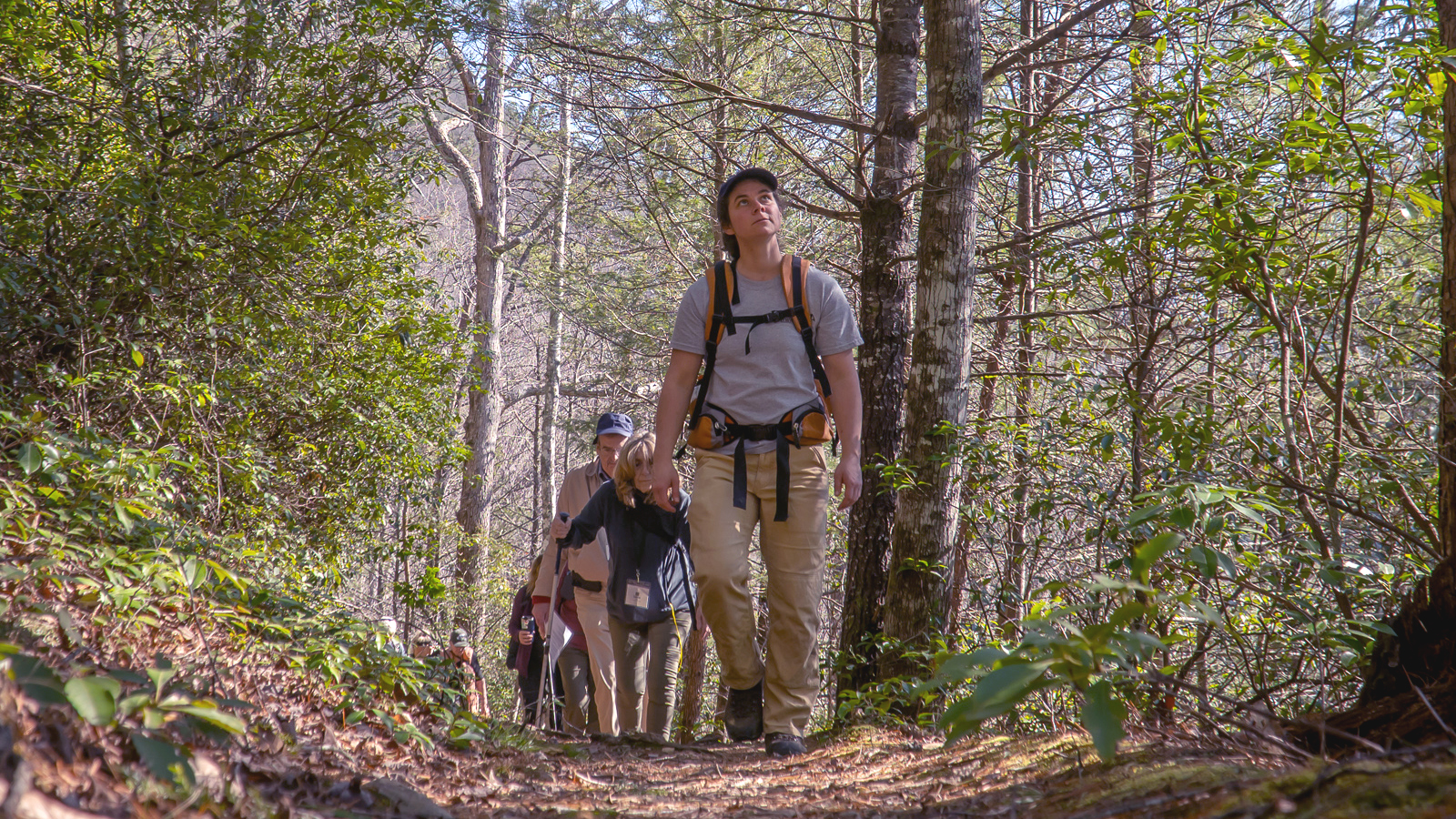
Elizabeth Davis may be a familiar face to friends of Tremont, but she has recently taken on a new role as Tremont’s first-ever Land Manager. Erin Rosolina, Director of Marketing, sat down for an interview with Elizabeth to find out more about what the new role means for Elizabeth and for Tremont.
Hi, Elizabeth! Thank you for taking some time out of your busy day for this interview. You’re already a well-known and much-beloved character at Tremont, but your role as Land Manager is new and I know folks will want to know what you’re up to. Tell us more about this Land Manager role. What is it, and why is it necessary?
As educators, we Tremonsters think quite a bit about what the world needs and, more specifically, what people need to be whole. And, more and more, we think of our role as doing the work of repairing connections in an increasingly disconnected world. Jonathan Haidt, a social scientist who researches mental health in the US and Europe, attributes recent trends of increasing loneliness and mental health crises to smartphone addiction, lack of play-based childhoods, and declines in community. Tremont’s programs address all of these and more by engaging people in meaningful, fun explorations that facilitate deep connections to nature, one another, and themselves.
When I think about program design, I think about the overlap between what people need and what the place has to offer. The Middle Prong, in many ways, defines our home campus in Walker Valley, so splashing in, exploring, sitting by, and sometimes “accidentally” falling in the river is clearly required. Our second campus is situated on the old Headrick Farm, where the Headricks raised cattle, grew tobacco and corn, kept pigs, and made a living since the 1940s. Earlier residents homesteaded, and for thousands of years, the Cherokee made their homes in Tuckaleechee Cove. In contrast, for many modern people, the industrial food system has shattered the connection between land and food.
The second campus offers an opportunity to build on the legacy of previous generations by demonstrating how human needs and the needs of the land aren’t exclusive, and, in fact, growing food can help support biodiversity, increase soil health, and mitigate climate change. In short, the second campus offers an opportunity to engage participants in projects that demonstrate tangible opportunities for hope.
And, to answer the question, this role is intended to develop and implement the land management plan that shapes these places where programming happens.
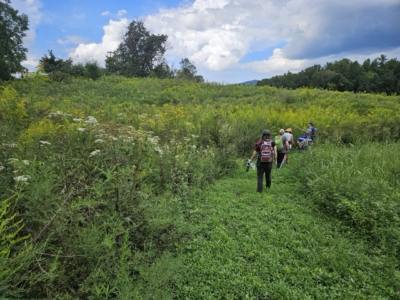
Teachers visiting Tremont’s second campus during a Teacher Escape Weekend.
I know that you and Jeremy Lloyd created a land use vision to help guide our work on the second campus. Can you share your approach to creating that document?
Articulating our land use vision was one of the rare fruits of Tremont’s forced closure during the pandemic. Being shuttered to programs allowed us time to focus on other projects. Jeremy and I met at the second campus (with his then-6-year-old and my dog in tow) on an almost-weekly basis, slowly discovering and recovering old, preexisting, overgrown trails and exploring the land. The physical rambling and ensuing rambling conversations led to the development of the land management vision. It was one of the small delights of the pandemic.
Talk to any land manager about their job, and if you chat for long enough, you’ll realize that they daily enact an underlying set of values. In the park, the Organic Act of 1916 and the Wilderness Act of 1964 heavily influence the values, resulting in management decisions that support recreation, wilderness, preservation of biodiversity, and cultural history. At our second campus, we borrow some values from the National Park Service – promoting biodiversity and dedicating the “backcountry” to wilderness and recreation – but we also enact practices that focus on sustainable and regenerative human relationships with the land through farming. No federal acts define our values, though they do support the Sustainable Development Goals developed by the UN. And, I’d be remiss not to credit Wendell Berry’s work in shaping our land use vision.
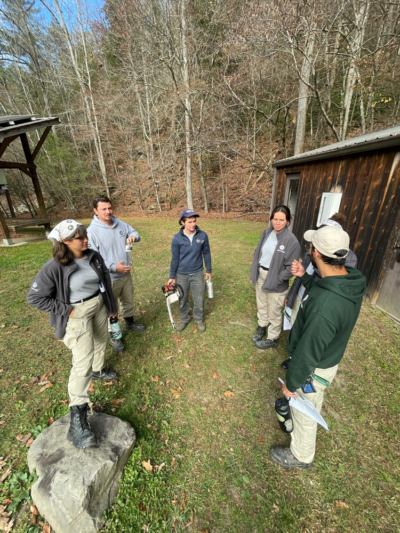
Elizabeth meeting with members of the AmeriCorps team that helped build trails on the second campus.
It sounds like there’s no lack of ideas for the second campus land. How are you actually spending your time? Are there any specific projects or initiatives that you’re particularly excited about?
Like many jobs at Tremont, it’s highly variable, and definitely sweaty. Last fall, we were fortunate to receive the help of an AmeriCorps NCCC crew, who lived for a month at our home campus in Walker Valley and helped reclaim and construct new trail at the second campus. I worked with them that month, teaching them about chainsaw use, trail construction, and forest ecology. I’m working to expand our volunteer workdays at the second campus so we can continue to clear trails, clean up downed trees (both at the second campus and in Walker Valley), and perform general maintenance. From 2020 to 2023, we had an exceptional group of volunteers treat over 800 individual hemlock trees for hemlock wooly adelgid. Serious thanks and kudos to them! (If you want to be a part of this project, we’ll need to re-treat beginning next year. Hit me up.)
Sometimes, I end up in conversation with neighbors. I have helped catch a neighbor’s orphaned calf that was wandering our fields, raced darkness to clear up a downed tree that fell in another neighbor’s pasture, and enjoyed some excellent muscadines, thanks to a neighborly exchange of garden produce. I’m also learning – meeting with potential partners to discuss possible future projects, attending chainsaw instructor training, and seeking out resources to develop a management plan. And working on projects I’ve written about previously: harvesting shiitakes from logs we inoculated in 2023, working with a professor from UT extension to mill boards from a fallen walnut, talking to our snake volunteer, Joe Gordon, working with research partners from universities, coordinating work with TN Forestry to implement a prescribed burn… I have a pretty much endless to-do list. But, it’s good!
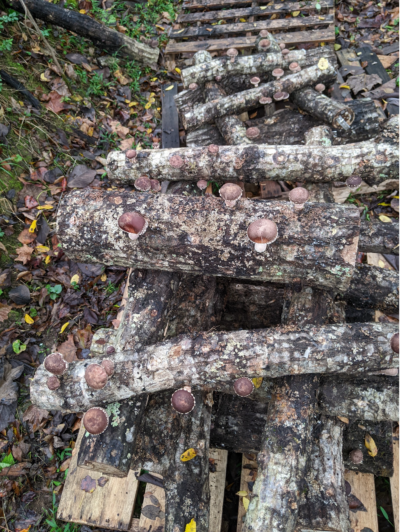
Shiitakes growing on the mushroom logs that Tremont staff and volunteers inoculated in spring 2023.
I’m particularly excited to start planting some native edible plants. I have some pawpaws I’ve started from seed that I’m looking forward to getting in the ground this spring. We’re continuing to clear an area of dense non-native invasive species that we plan to replant in a polyculture of native edible plants, like pawpaws, persimmons, walnuts, muscadines, and blueberries.
The second campus is designed to meet the Living Building Challenge and be a model of sustainability. How will your work as a Land Manager align with these goals, and what challenges or opportunities do you anticipate in this process?
The Living Building Challenge has seven “petals” or facets: place, water, energy, health and happiness, materials, equity, and beauty. The place petal asks us to “realign how people understand and relate to the natural environment that sustains us.” That aligns pretty nicely with Tremont’s mission and with our land use vision.
It’s also ambitious, and extends well beyond the footprint of our campus; the place petal asks us to be a part of a community with a “web of local and regional agriculture.” Being part of a network of local agriculture has never been more urgent. Tennessee may lose as much as a million acres of agricultural land to development by 2040; in Blount County, we’re projected to lose somewhere between 17,000-45,000 acres. If we do our work well, we can contribute to mitigating these losses by rewiring the connections between farms and people, people and nature, “inviting natural systems back into the daily fabric of our lives,” to borrow more language from the Living Building Challenge.
Homegrown National Park is an initiative that seeks to support landowners in collectively achieving landscape-scale conservation. Basically, if many landowners adopt conservation strategies on their land, they will provide a patchwork of habitat that can help support life, particularly migrating species and pollinators. While we’re definitely in the early stages of this project and have a long way to go, our goal is to eventually provide resources for landowners so we can collectively support healthier ecological and human communities in the region.
Will we still see you in Walker Valley? Will you still be a part of our programs?
I’ll still be helping with adult and college programs, so you may see me at a Southern Appalachian Naturalist Certification Program, Naturalist Week, or elsewhere. I’ll increasingly be recruiting volunteers and service-learning groups to help make projects at both campuses a reality, so if you’re interested in getting involved, let me know!
I’m sure lots of folks would love to join you for a day at the second campus. Thank you so much for sharing your thoughts and plans for the land – I can’t wait to see more of these projects come to fruition!
Related Living Building Challenge Petals

About the Authors
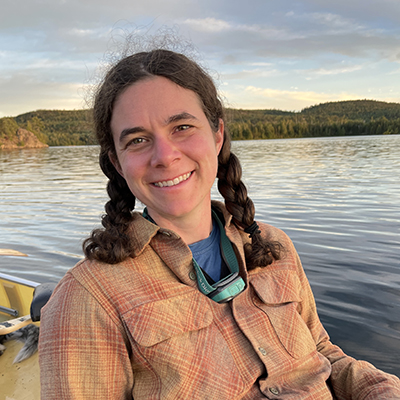
Elizabeth Davis is the Land Manager at Great Smoky Mountains Institute at Tremont. She is a native East Tennessean who grew up exploring and backpacking in the Southern Appalachians before moving away to the snowy mountains of the northeast. She received a B.A. in Environmental Studies and Conservation Biology from Middlebury College, worked at John C. Campbell Folk School in North Carolina, spent a few seasons at the Ashokan Center in the Catskills, and hiked from Maine to Georgia on the Appalachian Trail before finding her way back home. She has worked at Tremont full-time since 2014.

Erin Rosolina is the Great Smoky Mountains Institute at Tremont’s Marketing Director. She grew up in the mountains of western North Carolina where trillium, bloodroot and galax were everyday friends. Erin earned a degree in sustainable community development from Berea College in Kentucky, and then went on to receive the Compton Mentor Fellowship. Erin has worked in marketing with regional and national nonprofit organizations for over a decade and has been at Tremont since 2021.