
Selfie of Dr. Joe Gordon with a Cornsnake.
If you have ever met Dr. Joe Gordon, you likely walked away from the encounter with a little more appreciation for snakes. In addition to being a Johnson University professor, Tremont volunteer, and Southern Appalachian Naturalist Certification Program graduate, Joe is also an Amphibian Foundation Certified Master Herpetologist with a particular passion for snakes..
When he learned about our second campus property, Joe was quick to ask if he could set out a few covers to study the snake population. And, of course, we said yes.
These covers (sheets of plywood and metal) were placed around the perimeter of fields, creating habitats for both snakes and their rodent food sources. By frequently checking these covers, Joe is able to get a sense of which snakes are thriving on the second campus.
In Tremont’s 2022 Community Science Report, Joe wrote:
For our surveys, we check the boards and tin to see if any snakes are around and take temperature, time, and weather data, and record any other pertinent observations (the maturity of the snake, if it is preparing to shed, if it is digesting a meal). For non-venomous snakes, we try to get a good enough look at them to see if they are repeat captures (i.e. old friends) by handling them gently and briefly when possible.

Joe and Tremont staff checking a cover at the second campus. Photo by Erin Rosolina.
A Look Back: Year One

Cornsnake photographed by Dr. Joe Gordon.
2022 marked the first full year of snake population surveys. The year was a resounding success, with six different species documented:
- Cornsnake (Pantherophis guttatus)
- DeKay’s Brownsnake (Storeria dekayi)
- Midland Ratsnake (Pantherophis spiloides)
- Northern Black Racer (Coluber constrictor constrictor)
- Northern Ringneck Snake (Diadophis punctatus edwardsii)
- Eastern Copperhead (Agkistrodon contortrix)
The surveys revealed a consistent snake presence throughout the year, with only two surveys out of thirteen yielding no snakes.
Joe shared:
Snakes are important “middle-order” predators. They eat invertebrates, small mammals, birds, and other reptiles. Enough of those prey animals must be present at the second campus to support the snake population. In turn, the snakes are food for larger mammals, raptors, and even other snakes (Racers, in particular, are known for being ophiophagous, i.e. “snake-eaters”); they are thus a vital link in the food web.
Year Two: Continued Success and New Discoveries

Eastern Wormsnake photographed by Dr. Joe Gordon.
The second year of snake surveys resulted in fewer species, but one species was a new and exciting observation on the second campus – the Eastern Wormsnake (Carphophis amoenus amoenus). This brought the total species count for the property to seven.
In 2023, Joe and his team noted 34 distinct snake encounters, including multiple individual Racers, Ratsnakes, and Cornsnakes. This includes a surprising encounter in April where two Northern Black Racers were found mating under one of the tin covers, and this particularly notable observed behavior shared in Tremont’s 2023 Community Science Report:
In July, I witnessed a remarkable natural history event: one of the adult female Cornsnakes I encountered exhibited cloacal autohemorrhaging; in addition to normal musking, she excreted and smeared blood from the musk glands at the base of her cloaca (the multipurpose vent that snakes have for reproduction and waste elimination) on me. This probable anti-predator behavior has only been reported for a handful of snake species, and never for Cornsnakes.
Joe wrote a natural history note on the observation that has been accepted for publication in an upcoming Herpetological Review.

Naturalist Week participants meeting a Dekay’s Brown Snake. Photo by Erin Rosolina.
A Glimpse Into Year Three
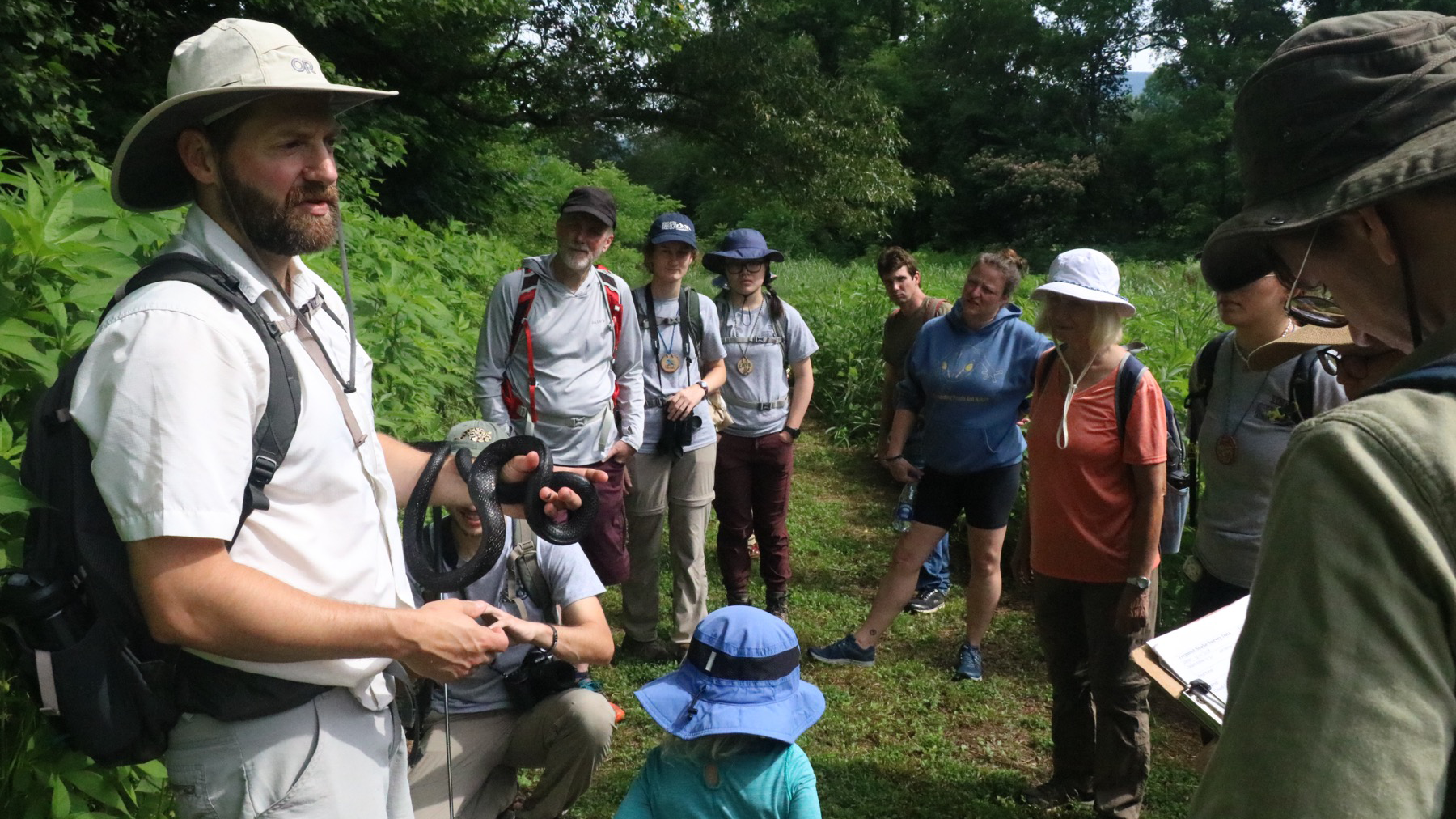
This summer, Joe led two groups to the second campus to help check the snake covers. Adult campers in our Naturalist Week camp and students in our Reptiles and Amphibians class walked the perimeter of the second campus, meeting several snakes along the way. Observations included a Northern Ringneck Snake and multiple Midland Ratsnakes. Participants were able to hold the snakes if they wanted to, gaining a better understanding and appreciation of these remarkable creatures.
As we continue to monitor and study the snake populations at Tremont’s second campus, we are reminded of the vital role these reptiles play in our ecosystem. Their presence not only reflects the health of our environment but also provides endless opportunities for learning and discovery. We extend our heartfelt thanks to Joe Gordon and all our volunteers, program participants, and students who have supported this project.
Cover image: Joe shows a Ratsnake to Naturalist Week participants. Photo by Erin Rosolina.


About the Author

Erin Rosolina is the Great Smoky Mountains Institute at Tremont’s Marketing Director. She grew up in the mountains of western North Carolina where trillium, bloodroot and galax were everyday friends. Erin earned a degree in sustainable community development from Berea College in Kentucky, and then went on to receive the Compton Mentor Fellowship. Erin has worked in marketing with regional and national nonprofit organizations for over a decade and has been at Tremont since 2021.