
It’s not often in the modern world that we have the opportunity to harvest raw materials and turn them into usable products. This winter, we did just that.
Look around the room where you are presumably reading this. (If you’re outside, kudos to you; now get off your phone!) Let your eyes rest on any object, and imagine the path it took on its journey to you. Likely, at least some of the raw materials were mined or extracted in a distant country, or at least another state. And likely they took a winding path, processed by machines, packaged and handled by many hands, and transported via more machines across land and sea.
Environmentalists often track the impact of this global economy by calculating the carbon footprint of products, and that’s certainly a worthwhile reason to buy local. This project, though local, was certainly not carbon-neutral; I used a chainsaw to fell the trees, rented a skidsteer to move the logs, and arranged for a portable bandsaw mill to process them. Some might condemn me for not being a purist, for using diesel and gasoline, and I would’ve certainly jumped on the opportunity to employ a good horse logging team, such as teamsters Jason Rutledge or Troy Firth, who would’ve left a lighter impact on the land. (Side note: if anyone knows a horse logger in East Tennessee, please introduce me!) But this isn’t about being a purist; it’s about a land ethic that reconnects our economic needs to our home turf.
Staff member Jeremy Lloyd wedges a white pine tree over

Measuring the logs to cut to length. (It snowed!) This tree was 130 feet tall.
As recently as a hundred years ago, using the trees grown in a place to build a house or a barn was the norm. The second campus barn was built in 1963 from trees harvested from the land. The roofing rafters were constructed of yellow pine polewood, peeled with a drawknife, and turned every few days to ensure the wood dried evenly and did not warp, and the oak posts and siding were milled on site.
Nowadays, most folks would probably skip the hassle and pick up some pressure-treated 4x4s from Lowe’s. In his essay, “Local economies to save the land and people” in the book Our Only World, farmer and author Wendell Berry writes that
“The loss of a saving connection between the land and the people begins… when the people remaining on the land are convinced… that they can’t afford to produce anything for themselves, but must employ all their land and all their effort in making money with which to buy the things they need or can be persuaded to want.”
Dependency on the global supply chain has far-reaching consequences, including not only carbon emissions, but also taxes, shipping costs and delays, tariffs, and potential for poor working conditions and inequitable pay, to name a few. True “homeland security” requires that we reclaim our connection to the land through economic means and produce at least a modicum of our food and shelter on our home soil. As Berry observed in the same essay, “the conversion of an enormous number of somewhat independent producers into entirely dependent consumers is a radical change.” That change has had ripple effects on our communities, politics, and economies, and also on our psyches.


Logs staged for milling, plus a new beatbox rhythm. (Try saying it fast: dogs and logs and dogs and logs and…)
The Living Building Challenge (LBC) recognizes the importance of short supply chains and includes a materials imperative that sets “a baseline for transparency, sustainable extraction, support of local industry, and waste diversion for all projects.” This imperative requires that “20% or more of the materials construction budget must come from within 500 kilometers of the construction site, and 50% of wood products must be FSC [Forest Stewardship Council certified], salvaged, or harvested on site either for the purpose of clearing the area for construction or to restore or maintain the continued ecological function of the site. The remainder must be from low-risk sources.”
These trees, which will be used in the pavilion, are about as local as can be. I felled them from within the future footprint of the entrance road and parking area, which is definitely within 500 kilometers of the construction site; I think, though I haven’t measured, that they were within 500 feet of the construction site.
Adam operating the sawmill. Thank you, Adam and Eddie, who brought the sawmill from UTK!

Logs waiting to be milled in the far right behind the mill, the offcut slabs in the far left, and the stacks of boards and cants (squared columns) in the distance.

12” x 12” x 12’ logs stacked by the barn, awaiting a shed roof to protect them from the elements while they dry. Each weighs over 600 pounds!
Don’t mistake this blog post for encouraging rugged independence or promoting individualism; if anything, it’s an homage to dependence. Transforming these trees to columns took a village. It involved the work of several staff to clear appropriate access to the trees, about 15 minutes of emphatic whaling with a sledgehammer by three staff to tip a backleaning tree over (the last minute or so of which is captured in the felling video above), a helping hand from a neighbor when the skidsteer broke down, the donation of time and equipment from the University of Tennessee’s wood science professor, Adam Taylor, and the help of multiple volunteers on milling day, stacking and moving very heavy slabs and boards.
That kind of dependence – on one another, on neighbors, on shared tools and borrowed knowledge, on the particular gifts of this particular place – is not a weakness. It is a way of remembering where things come from and what they cost, not only in dollars but also in labor, relationships, and care. In a culture that often hides those connections from us, these columns will hold up more than a pavilion roof. They will hold a story of trees that grew here, people who showed up here, and a building that is trying, in its own small way, to belong here.

The author, after felling a tree.


About the Author
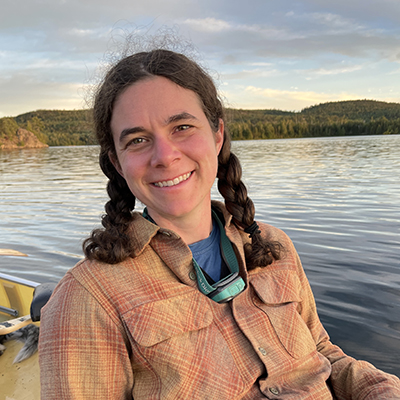
Elizabeth Davis is the Land Manager at Great Smoky Mountains Institute at Tremont. She is a native East Tennessean who grew up exploring and backpacking in the Southern Appalachians before moving away to the snowy mountains of the northeast. She received a B.A. in Environmental Studies and Conservation Biology from Middlebury College, worked at John C. Campbell Folk School in North Carolina, spent a few seasons at the Ashokan Center in the Catskills, and hiked from Maine to Georgia on the Appalachian Trail before finding her way back home. She has worked at Tremont full-time since 2014.